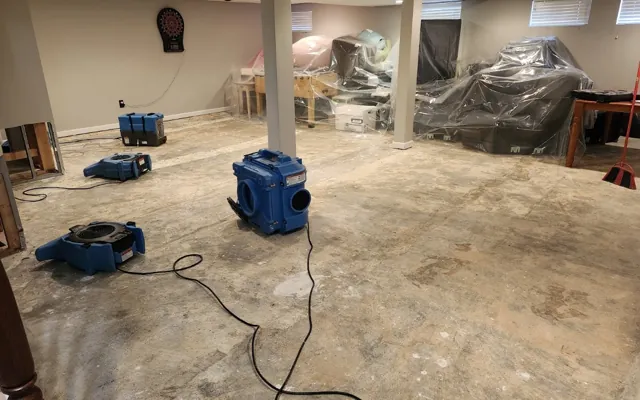
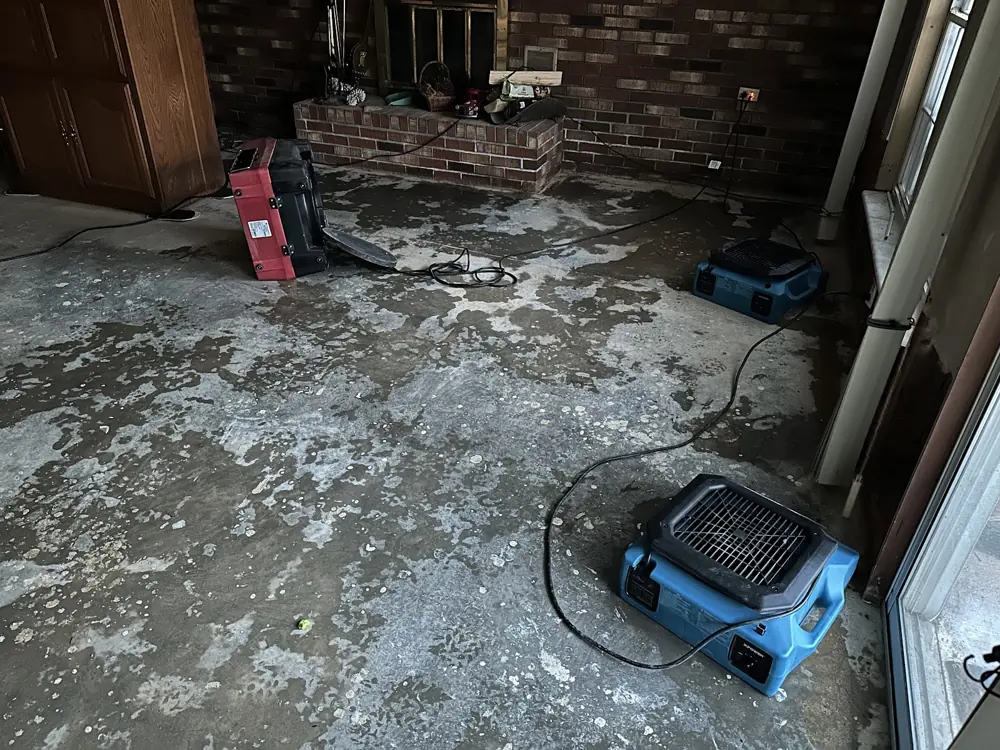
Sump pumps are not standard in most Denton homes, but where one is installed, in a crawlspace or a low-lying lot near a creek or lake, a failure during heavy rain can let water back up fast. Crews respond 24/7 to extract it and get the pump issue documented.

A crew is typically on site in about an hour to assess how much water has backed up and whether the pump or power supply failed.
Portable submersible pumps and extraction units manually clear the water the failed sump system was supposed to handle.
Floor joists, subfloor, or foundation-adjacent soil and materials are checked for saturation depending on where the pump was installed.
The affected area is dried to a verified moisture target, and the failed pump is documented and passed along to a qualified plumber for repair or replacement.

While help is on the way, these first steps, done only where it is safe, limit the damage and protect the insurance claim.
Shut the supply off at the source, or close the home's main valve if the source is not obvious. Stopping the flow limits the damage more than anything else.
Switch off electricity to the affected area, but only if the breaker can be reached without standing in or touching the water.
Get a crew dispatched right away. The sooner extraction and drying begin, the more flooring, drywall, and belongings can be saved.
Take photos and a short video of the water and the affected rooms before anything is moved, so the insurance claim starts strong.
Sump pump failure cleanup in Denton typically runs from about $500 to $2,500 depending on how much water backed up before it was caught and whether a crawlspace or finished space was affected, with the pump repair or replacement itself quoted separately by a qualified plumber. Because sudden pump failures during a storm are often treated as accidental water damage, coverage is commonly available under a homeowners policy, and the extent of backup and drying is documented with photos and moisture readings for the claim.
Crews reach Denton, Denton County, and the surrounding North Texas communities fast, from Downtown Denton, the Oak-Hickory Historic District, and Southridge to Corinth, Highland Village, Little Elm, and Lewisville. See the full list on the areas served across Denton page.
See all areas servedEvery loss is photographed, measured, and logged from the first visit, so the paperwork holds up with the insurance carrier.
Technicians follow recognized IICRC drying standards and prove it with daily moisture readings on Denton homes, not guesswork.
Emergency dispatch any hour of the day or night, with a real crew on the way across North Texas, not a callback in the morning.
A real crew dispatched any hour, not a callback in the morning.
Trained technicians following recognized IICRC drying standards.
Truck-mounted, portable, and submersible for any size loss.
The loss is documented and billed to the carrier directly.
No. Most Denton homes are built on a slab with no basement or sump system. Sump pumps are mainly found in older pier-and-beam crawlspaces or on lower-lying lots near water where groundwater management is needed.
A power outage during a storm, a clogged intake screen, or a motor that has simply worn out over time are the most common causes, and any of them can happen right when the pump is needed most.
No, water extraction and drying is handled directly, and the pump itself is referred to a qualified plumber for repair or replacement.
Sudden failures during a storm, including power-outage-related failures, are commonly treated as accidental water damage and covered by homeowners insurance. The event is documented for the claim.
A battery backup system and periodic testing can reduce the risk of an undetected failure, especially for pumps serving crawlspaces or low-lying properties during storm season.
Denton crews are on call 24 hours a day, local and fast, and can be on the way within the hour.
Call (940) 412-8500