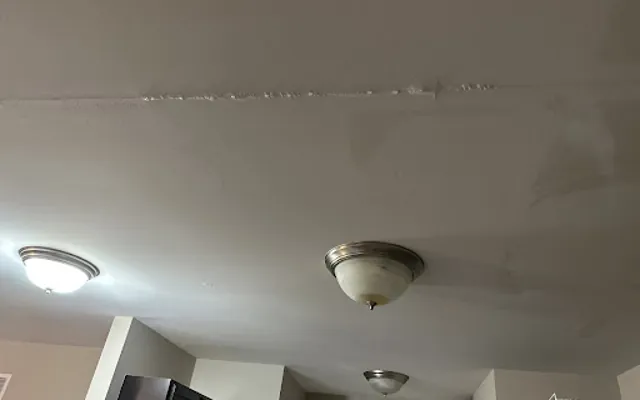
A brown stain spreading across a Denton ceiling almost always means water is still moving above it. Crews respond fast to find the source, stop further spread, and dry the cavity before drywall sags or lets go.

The crew traces whether the leak is roofing, an upstairs fixture, or an AC line, and checks for electrical hazards near light fixtures before touching the ceiling.
A small access point is opened at the lowest point of the sag to relieve trapped water safely, rather than letting the ceiling collapse on its own.
Saturated insulation is removed from the attic side or ceiling cavity, and any pooled water above the drywall is extracted.
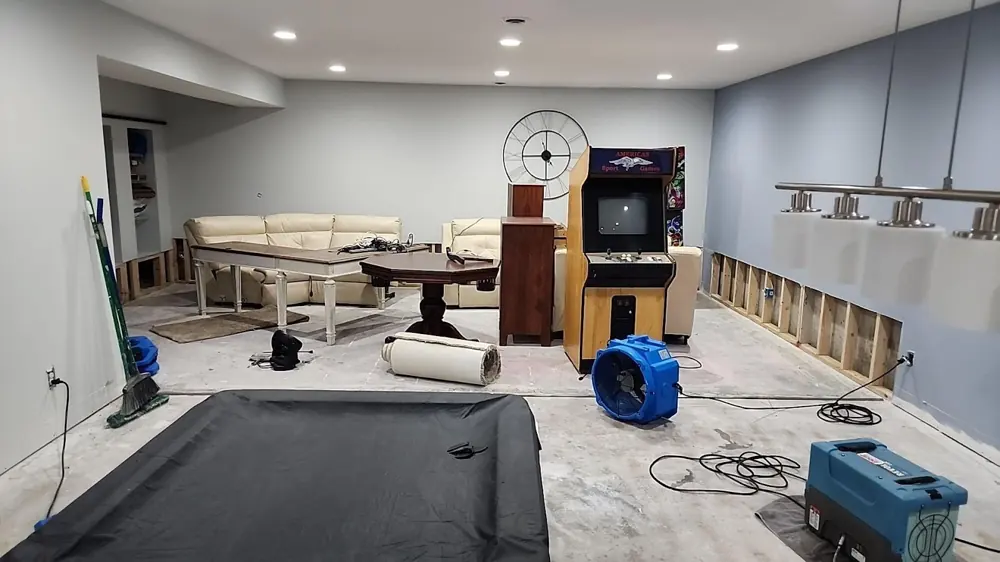
Air movers and dehumidifiers dry the remaining structure to a verified moisture target, and the opening is left ready for a qualified drywall contractor to close.

While help is on the way, these first steps, done only where it is safe, limit the damage and protect the insurance claim.
Shut the supply off at the source, or close the home's main valve if the source is not obvious. Stopping the flow limits the damage more than anything else.
Switch off electricity to the affected area, but only if the breaker can be reached without standing in or touching the water.
Get a crew dispatched right away. The sooner extraction and drying begin, the more flooring, drywall, and belongings can be saved.
Take photos and a short video of the water and the affected rooms before anything is moved, so the insurance claim starts strong.
Ceiling water damage cleanup in Denton generally runs from about $500 for a small, localized stain to $3,500 or more when insulation removal, a larger drywall section, and multi-room drying are involved. Roof-related leaks tend to run higher once a qualified roofer's repair is factored in separately. Most sudden leaks from a fixture failure or storm intrusion are covered by homeowners insurance, while long-term roof neglect may not be, so the source and history of the leak are documented carefully for the claim.
Crews reach Denton, Denton County, and the surrounding North Texas communities fast, from Downtown Denton, the Oak-Hickory Historic District, and Southridge to Corinth, Highland Village, Little Elm, and Lewisville. See the full list on the areas served across Denton page.
See all areas servedEvery loss is photographed, measured, and logged from the first visit, so the paperwork holds up with the insurance carrier.
Technicians follow recognized IICRC drying standards and prove it with daily moisture readings on Denton homes, not guesswork.
Emergency dispatch any hour of the day or night, with a real crew on the way across North Texas, not a callback in the morning.
A real crew dispatched any hour, not a callback in the morning.
Trained technicians following recognized IICRC drying standards.
Truck-mounted, portable, and submersible for any size loss.
The loss is documented and billed to the carrier directly.
A stain by itself is not always urgent, but a growing stain, sagging drywall, or a stain that appears during or right after rain usually means active water intrusion and should be checked quickly.
A controlled opening at the lowest point lets trapped water drain safely instead of the ceiling collapsing under its own weight. It also gives access to remove wet insulation and dry the cavity properly.
It depends. Roof leaks often follow storms and appear near exterior walls or valleys, while plumbing leaks from an upstairs bathroom tend to appear below that fixture regardless of weather. The source is traced before repairs are recommended.
Wet insulation loses its effectiveness and is typically removed rather than dried in place. Dry sections nearby are usually left alone once moisture readings confirm they were not affected.
Sudden leaks from a fixture failure or storm-driven rain are commonly covered. Damage traced to long-neglected roof maintenance may be treated differently by the carrier, so the source and timeline are documented carefully.
Denton crews are on call 24 hours a day, local and fast, and can be on the way within the hour.
Call (940) 412-8500